Our health is shaped by more than what happens in an exam room. How we eat, move, rest, and respond to stress can all play a part. That does not mean we need to manage everything alone or make every choice perfectly. In this excerpt from Whole Woman Health, I reflect on the partnership between medical care and our own participation, and why the way we live deserves a place in conversations about health.
How You Live Matters
Incorporating personal lifestyle modifications into a plan of care—supporting someone as they make different choices about the way they live—is one of the most significant factors differentiating functional medicine from conventional medicine. In functional medicine, restoring health is not solely dependent upon whether or not someone took their medication. Nor does a person’s health lay solely in the hands of the practitioner. It is not entirely up to me to “make” someone better any more than it is up to someone else to help me feel better. If I tear a ligament in my knee and I want to continue to hike and ski, I put my health in the hands of the surgeon for the surgery. But after surgery, a full recovery depends on my participation in physical therapy. Similarly, if I’m in a major motor vehicle accident and I’m bleeding internally, I am grateful to the surgeon who can stop the bleeding. In those scenarios, I completely hand over my power to the practitioner. But only temporarily.
Now, if I have high blood pressure and a family history of high blood pressure, and I am not exercising regularly or eating lots of vegetables, and I do not have a spiritual practice that quiets my central nervous system, why would I, or my health-care practitioner, expect a pill to correct my blood pressure—especially given the frequent ineffectiveness of blood pressure medication? When one medication fails to treat high blood pressure, a second medication is often prescribed. Even when medication normalizes blood pressure, the underlying biochemical imbalance causing the high blood pressure will manifest as another symptom in another system.
Conventional medicine treats symptoms. Conventional medical practitioners typically prescribe a “pill for an ill.” Taking multiple medications, also known as polypharmacy, creates its own health problems. The net effect of any particular cocktail of medications is unstudied, thereby making it impossible to distinguish symptoms from what might be the cumulative effects of taking multiple medications. When the line between what is a symptom and what are the cumulative side effects of medical treatment of a symptom becomes murky, the importance of getting to the root cause is even more important.
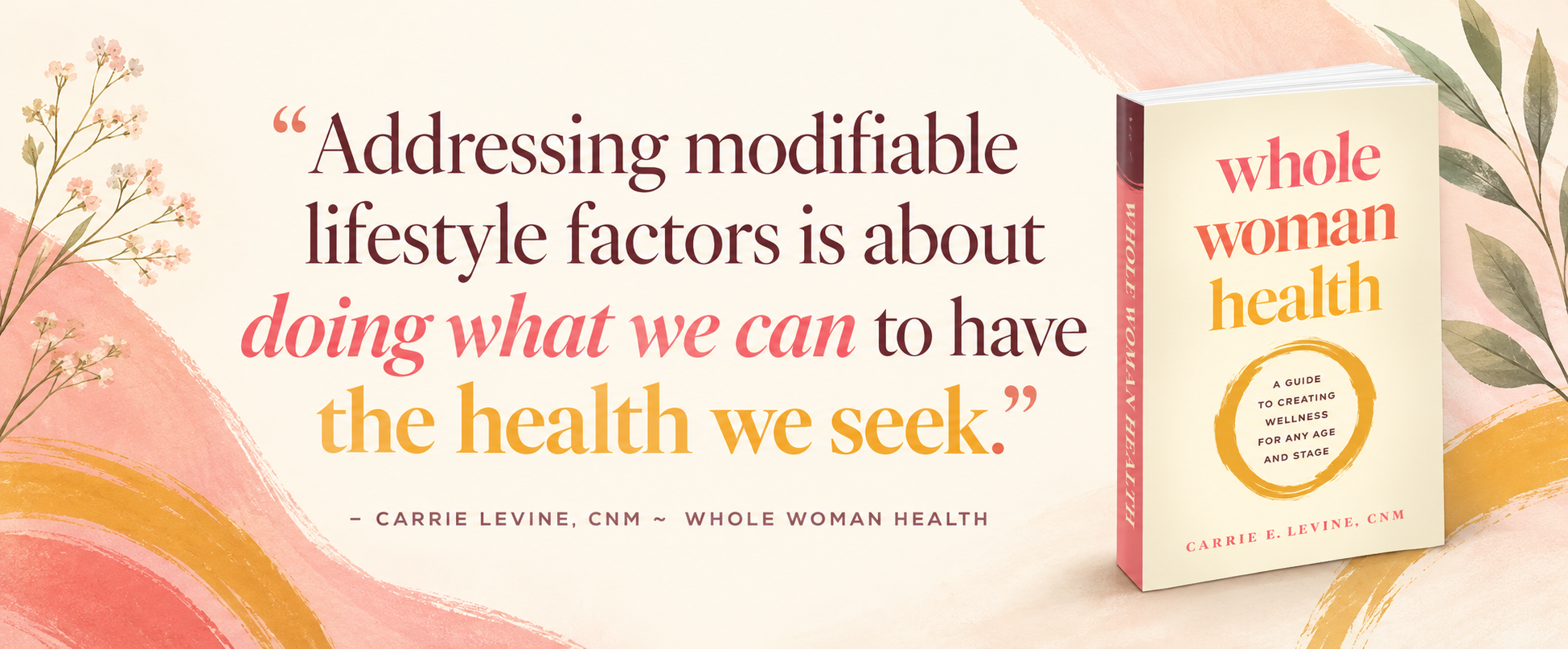
Addressing modifiable lifestyle factors is about doing what we can to have the health we seek. It’s about tabling the false expectation that something or someone can or will make you better. Other things and people can help, for sure. But for optimal health, your participation is required.
Excerpt from page 46 of Chapter 2, “The Foundations of How You Live,” in Carrie Levine’s Whole Woman Health: A Guide to Creating Wellness for Any Age and Stage.
If this passage resonates with you, I explore these ideas and more in Whole Woman Health: A Guide to Creating Wellness for Any Age and Stage. The book offers an approachable introduction to functional medicine and whole-person care, with practical ways to connect the dots in your own health. Visit Amazon, my book page, or your favorite bookstore to learn more and order a copy.

If you’d like to continue learning with me, I invite you to subscribe to my weekly newsletter, sent on Fridays. I share practical, evidence-informed guidance on women’s health, hormones, nourishment, and lifestyle practices that support long-term wellbeing.
When you sign up, you’ll receive my free guide on how to eat in a way that supports your health—without dieting.
As with all of my articles, blogs, social media posts, etc, this article is educational and not a substitute for medical care. Please check with your clinician before changing your routine.